


MYOPIA MANAGEMENT
Over one-third of the world’s population has myopia, and this could increase to 50% by 2050.
With myopia (short-sightedness) rising among children, effective management is more important than ever. At Paul Whiteman Optometrists we provide MYOPIA MANAGEMENT. Our experienced practitioners can play a central role in caring for young patients’ vision by employing specialist spectacle and contact lens techniques designed to reduce the development of myopia.

What is myopia management?
Myopia management refers to a range of clinical methods and interventions designed to slow the progression of myopia (short-sightedness) in children and adolescents.
While myopia typically starts to develop between the ages of 7 and 13, it can be present and diagnosed in much younger children.
Myopia occurs when the eye grows too long from front to back, causing distant objects to appear blurry. The goal of myopia control is to reduce the risk of high myopia, which is associated with a greater likelihood of serious eye conditions in later life such as retinal detachment, glaucoma, and myopic maculopathy.
Myopia may be hereditary, meaning that, if one or both parents are myopic, there’s a much higher chance that their children will be too.
Research in recent years has found other factors which can lead to the development of myopia, in part, due to the increased use of handheld electronics and less time spent outdoors.
See FAQs below for further information.

Our optometrists role in myopia management
Supporting Your Child’s Vision
With myopia (short-sightedness) rising among children, effective management is more important than ever. At Paul Whiteman Optometrists, our experienced practitioners play a central role in caring for young patients’ vision and reducing future risks.
Early Detection and Personalised Care
Our optometrists use the latest technology to detect myopia early and create tailored management plans for each child. Interventions may include:
Myopia control glasses.
Myopia control contact lenses.
Guidance on removing the ‘triggers’ for myopia including lifestyle modifications, increasing outdoor activity and reducing screen time.
Ongoing Monitoring and Family Support
Managing myopia is not a one-time event—it is an ongoing journey. Our optometrists will schedule regular check-ups to track progress and adjust treatment, ensuring the best outcomes. They will also work closely with families, educating parents and children about myopia and healthy vision habits.
Treatment strategies for myopia
-
![Package of CooperVision MiSight 1 day contact lenses for children with myopia on a turquoise background with text about myopia experts and clinically-proven contact lenses.]()
Contact lenses
Designated contact lenses offer one of the most effective methods of reducing myopia and often form part of a complete myopia management regime. involving a comprehensive eye examination to assess a child's vision and determine the most appropriate myopia control method based on their specific needs and eye health.
-
![Child with glasses smiling in the foreground, two additional children playing with large colorful balls in the background.]()
Myopia spectacles
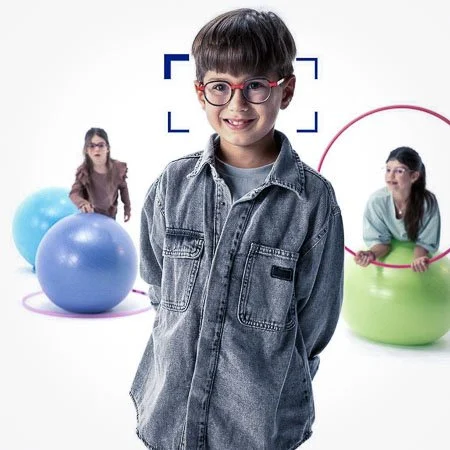
Myopia spectacle lenses are specially crafted to correct nearsightedness. These lenses, together with a well fitting frame, help focus light correctly onto the retina, improving distance vision and reducing eye strain. At Paul Whiteman Optometrists, we often use ZEISS MyoCare lenses. Tailored to individual prescriptions, MyoCare lenses ensure both comfort and optimal visual clarity.
-
![A boy lying on a wooden table, looking at a smartphone in his hand.]()
Remove the 'triggers' for myopia
The triggers for myopia in children are believed to be multifactorial, involving both genetic and environmental factors. Key contributors include prolonged near work activities such as reading, screen time, other close-up tasks & visual stress. Insufficient outdoor exposure, particularly a lack of natural daylight, has also been identified as a significant risk factor.

“ Specialist contact lenses, MiSight® 1 Day, have been shown to reduce the development of myopia by 50% ”


Online resource for parents of myopic children
My Kids Vision™ is a comprehensive online resource for parents supporting their child’s eye health journey and aims to help parents to better understand myopia and its impact on daily life.
From helping parents to assess their children’s risk of myopia to answering frequently asked questions and sharing articles contributed by eye care practitioners from all over the world.
FAQs - Myopia management
The following information is advice produced by the College of Optometrists to help understand what myopia is and how in can be managed.

FAQ’s - General information about myopia

-
Myopia is also known as being short-sighted or near-sighted. If you are short-sighted you have problems seeing things in the distance clearly, but can see things that are close. There are different degrees of short-sightedness.
-
Myopia is usually due to the eye being slightly too long. This means that light focuses in front of the retina at the back of the eye, rather than focusing on it.
-
Symptoms of myopia include having difficulty seeing things in the distance. This means you or your child might have to move closer or narrow your eyelids (called “squinting”) to see things clearly. Your optometrist can detect if you have myopia during a sight test.
-
The exact causes of myopia are not fully understood, so it is difficult to predict how myopic a person may become in the future. We know that the following things may make it more likely that a child will become myopic:
– having one or both parents with myopia.
– being of east-Asian ethnic origin.
– spending limited time outdoors.
– prolonged near vision activities.
Becoming myopic before you are nine years old may increase your risk of developing a high level of myopia.
-
Myopia makes your distance vision blurry, so you need to wear glasses or contact lenses to help you see clearly.
If you have a high level of myopia, you will be at a slightly greater risk of developing conditions such as retinal detachments, glaucoma and myopic retinal degeneration later in life. These conditions can lead to sight loss.
If you have myopia it is important to have regular sight tests with an optometrist. This is so they can pick up as early as possible any conditions that could affect your sight.
-
Myopia is usually easy to correct with glasses and contact lenses. Some adults with myopia have laser surgery to correct it. There are some treatments that may slow down myopia during childhood. This is called myopia management or myopia control. See FAQs below called, ‘FAQs - Treatments for Myopia’.
FAQ’s - Preventing myopia
-
Spending more time outdoors can help prevent or delay myopia developing. This is particularly important for children at higher risk of developing myopia. We think doing this can also help slow down how quickly myopia increases, but we need more research on this to be sure. Reducing prolonged near work, such as screen use, may also help prevent myopia development
-
Long periods of reading and screen use (phones, tablets, laptops and computers) may have an impact on myopia development, but the evidence is not strong. This does not mean these activities should be completely stopped, but should be balanced with spending more time outdoors. When reading or using screens for a long time, you should take regular breaks to rest your eye muscles and blink to keep them comfortable. We recommend the 20-20-20 rule. Every 20 minutes, take a break for approximately 20 seconds and look at an object at least 20 feet away. You also need to ensure that your screen is rightly positioned and display settings are set-up properly. Please see here for more information on screen use.
-
Long periods of reading and screen use (phones, tablets, laptops and computers) may have an impact on myopia development, but the evidence is not strong and we do not yet know why this happens. Spending time on these activities might mean your child will spend less time outdoors, which we know can help prevent or delay myopia developing.
We know that the following things may also make it more likely that a child will become myopic:
– Having a parent with myopia.
– East- Asian ethnic origin.
– Spending limited time outside.
-
Some people find that looking at screen for a long time is tiring, but there is no evidence to suggest that using a screen damages the eyes. You should take regular breaks when using a screen to rest your eye muscles and blink to keep them comfortable. We recommend following the 20-20-20 rule. Every 20 minutes, take a break for approximately 20 seconds in which you look at an object at least 20 feet away. You also need to ensure that any screen used is rightly positioned and display settings are set-up properly, please see here for more information on screen use.
FAQ’s - Treatments for myopia

-
Your child will be prescribed traditional glasses or contact lenses if they are diagnosed with myopia. These will improve how well they can see, but it will not change how quickly their myopia develops.
-
There are some treatments that may slow down myopia during childhood. This is called myopia management, or myopia control.
Different myopia management treatments are available in the UK. These are:
– Myopia management contact lenses.
– Myopia management spectacles.
– Orthokeratology lenses. These are a type of contact lens that are worn at night and removed during the day.
-
We know that myopia management glasses, myopia management contact lenses and orthokeratology lenses have similar results.
-
If you have a high level of myopia, you will be at a slightly greater risk of developing conditions such as retinal detachments, glaucoma and myopic retinal degeneration later in life. These conditions can lead to sight loss.
We do not yet know the long-term impact of myopia management on conditions that could lead to sight loss later in life. Reducing a child’s level of myopia may slightly reduce their risk of these conditions. However, it is not possible to remove the risk completely.
There isn’t enough evidence yet to know if the long-term benefits of myopia management outweigh the costs. Because of this, you might choose to continue to use traditional glasses or contact lenses instead of myopia management.
-
Myopia management is not currently funded by the NHS. That means you have to pay privately for treatment. The cost is generally more expensive than traditional glasses or contact lenses. Our optometrists can give you more information about the costs.
-
We know that wearing myopia management glasses does not have any more risks than wearing traditional glasses.
The risks of wearing myopia management contact lenses are similar to the risks of wearing traditional contact lenses. Some people have mild discomfort and blurred vision. There is a risk of serious complications, such as corneal infections that may result in sight loss, but this risk is low. There is a higher risk of complications if you wear contact lenses overnight.
If your child wears contact lenses, it is important that they follow your optometrist’s advice about hygiene and caring for the lenses. They should also have regular contact lens check-ups to prevent complications. It is important for you to make sure your child is following our optometrists’ advice correctly.
-
There is no minimum age when myopia management treatment can be started. However, for contact lens and orthokeratology treatments your child needs to be old enough to be able to carefully use and look after their lenses. Our team will show them how.
-
We need more research before we can be sure of the best age to end myopia management treatment. Experts currently believe that children should stop using myopia management in their late teens. Your child may need to restart their treatment if their myopia starts to get worse again after their treatment has stopped.
-
An optometrist may use a calculator to predict the impact of myopia management treatment. However, it is not possible to know for certain how successful their treatment will be. We will examine your child’s eyes regularly and will explain how we will measure the results.
Your child may not respond to myopia management treatment as expected. They may need to change to a different treatment, or to try a combination of treatments if the first choice does not slow down myopia development.

-
From going to the park, to riding your bike and looking at the scenery far away in the distance gives your eyes a chance to relax.
-
All that time spent in front of bright screens can strain your eyes. Its time to step away from your tablet … and your computer and your TV. Oh, and your smartphone too, if you have one.
Sorry. Your eyes will thank you!
-
We know it’s tempting to curl up close to your screen but there is some evidence that this could increase the chance of short-sightedness or myopia. We suggest keeping devices and books at least the same distance as your ‘knuckle to your elbow’.
Go on, give it a try!
-
Did you know you can get special contact lenses and glasses that not only help you to see clearly, but can slow down how quickly your sight may change.
Our optometrists can chat with you about this and explain how they work.
-
Having a good quality night’s sleep can help with myopia, so make sure you’re getting enough shut-eye.
